First ride
Your first time horseback riding
What to expect on a guided trail ride, from booking to climbing down at the end. You don't need any riding experience, just a willingness to listen to your guide.
Most people's first time on a horse is a guided trail ride. You book a time, a guide matches you with a horse, and a small group rides out together along a set trail. You don't need to know how to ride before you go. You do need to listen, be honest about your experience, and follow the stable's rules.
Trail ride or lesson?
There are three common ways to start, and it helps to know which one you're booking.
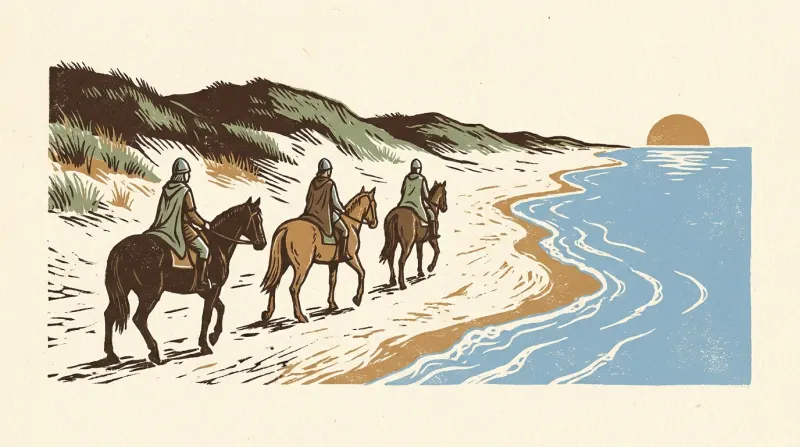
- A guided trail ride. You ride in a line behind a guide, mostly at a walk. You learn just enough to steer and stop, and the point is the scenery and the experience. This is what most first-timers book. Browse stables with guided trail rides.
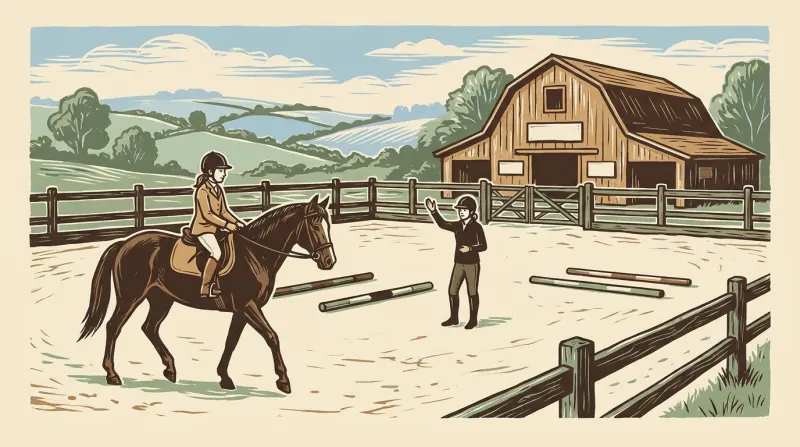
- A riding lesson. You ride in an arena with an instructor, and the point is learning to ride. It's the better choice if you want to keep riding. See stables with riding lessons.
- A pony ride. For small children, a handler leads the pony on foot the whole time. See pony rides.
Some stables say outright that they welcome riders with no experience. Our list of stables that welcome beginners shows the review or website line behind each one.
Booking your ride
Book ahead, especially for weekends, holidays and the busy season. Many trail stables take reservations only and won't have room for walk-ins. When you book, it's worth asking a few questions:
- What are your rider requirements? Most stables set their own minimum age, and many set a rider weight limit to protect their horses' backs. These differ from stable to stable, so ask before you plan around a ride, especially with kids or a mixed group.
- What experience do I need? Some rides are walk-only and fine for anyone. Others include trotting or loping and are meant for riders who already have some skills.
- Do you provide helmets? Many stables lend riding helmets, and some require every rider to wear one.
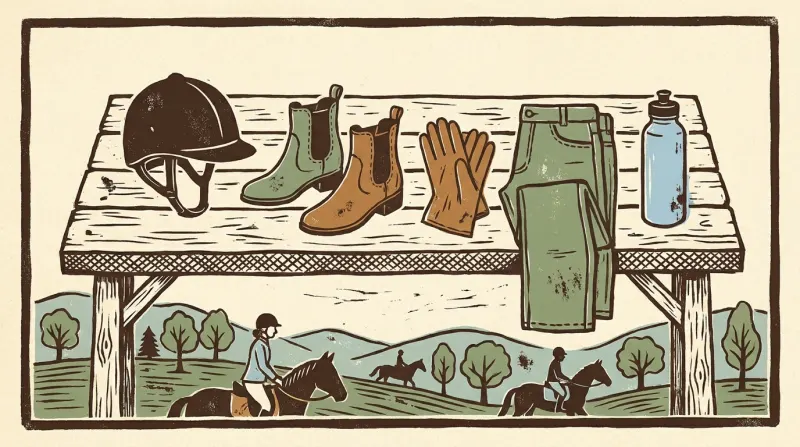
- What should I wear? Most stables ask for long pants and closed-toe shoes or boots. Our guide to what to wear horseback riding has the details.
- What happens if the weather turns? Ask about the cancellation and weather policy before you pay.
Tip
Tell the truth about your experience and, if the stable asks, your weight. The guide uses it to pick the right horse for you. A rider who says "I've ridden lots" after one pony ride can end up on a horse that expects more from them.
When you arrive
Arrive early. Expect to check in and sign a release form. Almost every stable asks riders to sign one, and parents or guardians sign for minors. Staff will then fit helmets and give a short talk about how the ride works and what the rules are.
Next, the guide matches each rider with a horse. While you wait, a few habits keep everyone comfortable around the horses:
- Walk up to a horse where it can see you, toward its shoulder, rather than straight from behind.
- Speak in a normal, calm voice and move slowly. Horses notice sudden movement.
- Don't feed a horse unless staff say it's fine. Some stables don't allow it at all.
- Keep kids close and stop them from running around the horses.
Getting on
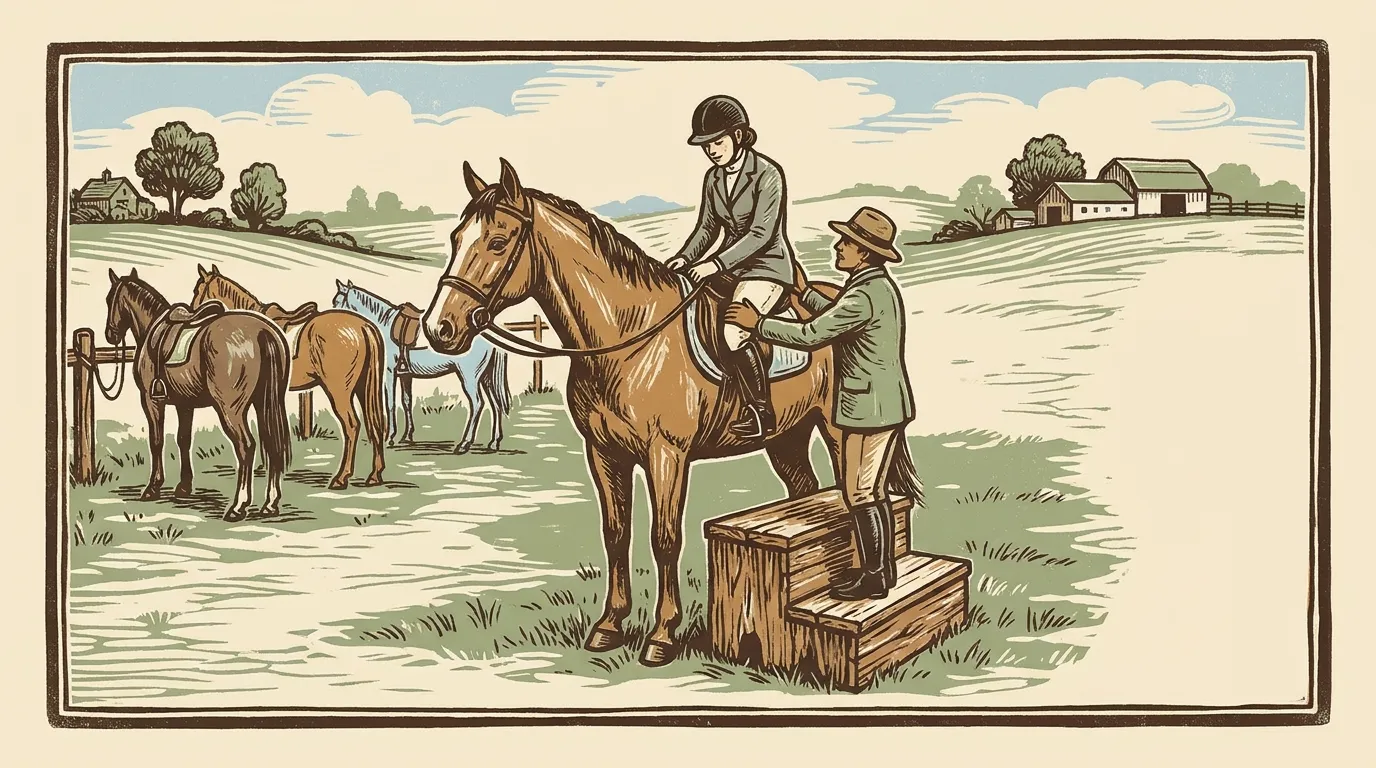
Most stables have you climb onto a mounting block, a set of sturdy steps that brings you up to stirrup height. Riders usually get on from the horse's left side. A staff member holds the horse while you put your left foot in the stirrup, swing your right leg over the horse's back and sit down gently in the saddle. If the stable does it differently, follow their lead.
Once you're up, staff adjust your stirrups so they fit your legs. They'll show you how to hold the reins. On many trail rides that's in one hand, Western style, with a little slack. Take a moment to settle in. Sit tall, let your legs hang down long, and push your weight gently down into your heels.
The cues you need
You only need a few signals for a guided ride. Trail horses know the routine and tend to follow the horse in front, so your main job is to stay balanced and keep your horse moving with the group.
- Go
- Give a gentle squeeze with both lower legs. If nothing happens, squeeze a little firmer. There's no need to kick hard.
- Stop
- Sit deep in the saddle and pull back on the reins with steady, gentle pressure. Many guides teach horses to answer to "whoa" too. Let go of the pressure as soon as the horse stops.
- Turn
- With one-handed Western reins, move your rein hand a little in the direction you want to go and the horse turns away from the rein against its neck. With two hands, draw the rein on the side you want to turn toward. Your guide will show you which the horse knows.
- Position
- Sit up straight, look ahead between the horse's ears, keep your heels a little lower than your toes, and keep your hands low and quiet.
Don't wrap the reins around your hands, and don't let go of them completely. If you feel off balance in a Western saddle, it's fine to hold the horn at the front of the saddle with your free hand.
On the trail
Most guided rides move in single file at a walk, with the guide at the front and sometimes a second guide at the back. A few things will come up along the way:
- Spacing. Keep the gap the guide asks for, often about one horse length. Riding right up behind another horse can upset it.
- Grazing. Horses love to snatch grass along the trail. Don't let them. Shorten the reins and keep the horse's head up with steady pressure.
- Hills. Going uphill, lean slightly forward and let the horse use its head and neck. Going downhill, sit up straight and stay balanced over the middle of the horse.
- Faster gaits. Only trot or lope if the guide offers it and you're comfortable. Say so if you'd rather keep walking.
- Phones and jackets. Keep your phone in a zipped pocket and only take photos when the guide says it's a good moment. Don't take off a jacket while you're riding. A flapping coat can startle a horse, so ask the guide to stop the group first.
If anything feels wrong, such as a loose saddle, a stirrup that's too long or a horse that won't settle, tell the guide straight away. Guides would much rather fix a small problem early.
Getting off, and the next day
Wait for the guide's signal before you get off. To dismount, take both feet out of the stirrups, lean forward a little, swing your right leg over the horse's back and slide down on the left side facing the saddle. Land with your knees soft. Staff are usually there to hold the horse and help.
Expect some stiffness in your inner thighs, hips and lower back the next day, even after a short ride. Riding uses muscles most people don't use much. A walk and some gentle stretching help.
If you enjoyed it, lessons are the natural next step. Our guides to choosing riding lessons and English vs Western riding explain how to start.
Questions
- Do I need any riding experience?
- Not for most walk-only guided rides. Tell the stable you're a first-timer when you book so they can match you with a calm horse and the right ride.
- Is there an age minimum or a weight limit?
- Most stables have both, and they set their own. We don't list them because they differ and change, so ask the stable before you book.
- What if I'm nervous?
- Say so. Guides see nervous first-timers every day. They can put you on a quiet horse, keep you near the front, and check on you during the ride.
- Is horseback riding risky?
- Horses are large animals, and riding always carries some risk, even on a calm horse at a walk. Wear a helmet, follow the stable's rules and your guide's directions, and speak up if something doesn't feel right.
- How much does a trail ride cost?
- It varies by stable, ride length and season, so we don't list prices. Each stable's own website or booking page has its current rates.
Find a stable for your first ride
- Guided trail rides, by state.
- Stables that welcome beginners, with the review or website line behind each one.
- Pony rides for small children.
- All riding stables by state, with a map of each city.